

Why treat compressed air
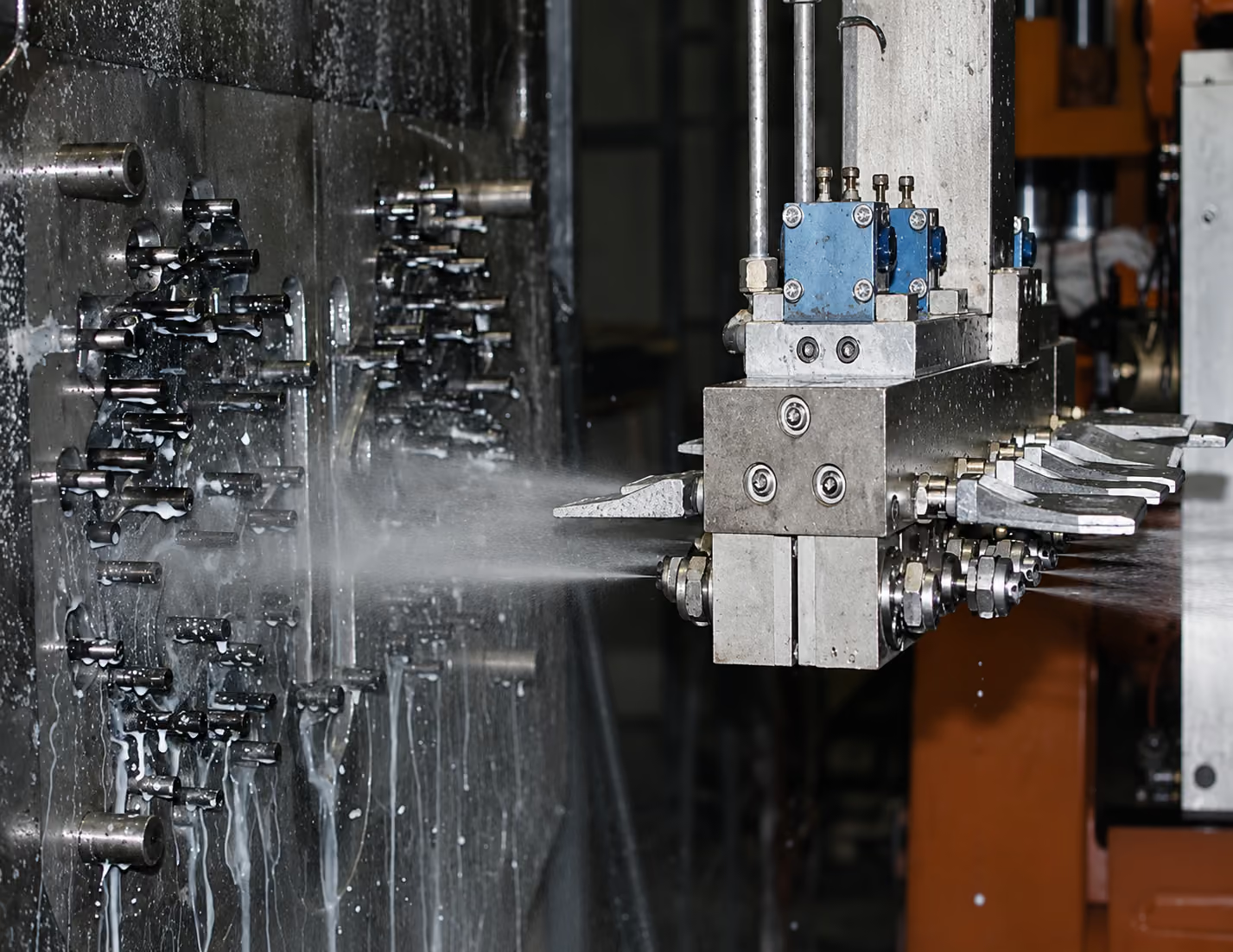
Isocyanate in polyurethane reacts with moisture to generate CO2: bubbles and porosity trapped in the casting, a collapsed surface, a part to be scrapped. The air used to atomize the release agent is one of the most common ways moisture reaches the mould.
Unstable air alters the lubricant spray pattern: under-oiled areas cause tears and incomplete deep drawing, while excess oil affects surface quality and complicates bending, welding or assembly.
Uneven release agent application causes parts to stick, air entrapment and build-up on the mould. Every stuck part means line downtime and extra mould cleaning.
The Evans system advantage
From the single mould in a workshop to the automated moulding line, Evans sizes the air treatment to the number of stations, the type of process — sheet metal or polyurethane — and the flow required by the spray guns.
Site survey, sizing, installation and testing included.
Request information →Manual application of release agent or lubricant at one station. Compact installation on the existing compressor.
Several moulds or presses in sequence. Modular system calibrated to the number of spray guns.
Multiple presses or automated RIM lines. Centralized system with remote air quality monitoring.
The Evans system can be interconnected with the production line: real-time monitoring of pressure, temperature and dew point, automatic alerts, and data for the Industry 5.0 tax credit.
FAQ
Isocyanate in polyurethane reacts with moisture, generating carbon dioxide that traps bubbles and porosity in the casting. The compressed air used to atomize the release agent in the mould is one of the most direct ways moisture reaches the reaction cycle. Dry air reduces this risk at the source.
The lubricant is spray-applied with compressed air. Unstable or contaminated air alters the spray pattern, producing under-oiled areas — which cause tears and incomplete deep drawing — or areas with excess oil, which affect surface quality and complicate downstream operations.
Yes. Uneven release agent application, often caused by unstable atomizing air, is one of the most common causes of parts sticking and build-up on the mould. Air at constant pressure and quality guarantees even wetting of the mould at every cycle.
Yes. Evans sizes the treatment to the number of stations and the total flow required by the spray guns, on both manual systems and automated RIM lines.
Yes. Evans installs downstream of the existing compressor without changing the main network, sizing the treatment to the total flow required by both processes.
For a single-mould workshop, installation and testing typically take one working day. On multi-station industrial lines, Evans plans the work to minimize production downtime.


